

At some point in our early forties, a quiet realization sets in: the body has stopped grading on a curve.
In our twenties and thirties, nutritional indiscretions were easily dismissed. A skipped breakfast, a late-night diner run, or a weekend of culinary indulgence barely registered on our daily energy ledger. We operated under the comfortable assumption that our metabolism was a static, forgiving engine. But as the decades accumulate, the margin for error shrinks. Suddenly, the afternoon slump is no longer solved by a second espresso; it lingers, a heavy, stubborn fog that dulls our focus and dampens our momentum.
Too often, our instinctual response to this shift is to treat our bodies with a sort of punitive restriction. We look at the changing contours of our physical selves and decide we must eat less, strip away joy, and rely on sheer, white-knuckled willpower. But this approach misunderstands the biology of aging. At midlife, the body does not need fewer nutrients; it needs a more sophisticated delivery of them. We are not experiencing a failure of willpower, but a shift in cellular communication.
Understanding Nutrition as Cellular Information

To understand how to eat after forty, we must first abandon the antiquated view of food as mere calories—as fuel to be burned in a furnace. Food is not just thermal energy. It is a complex stream of biological data. Every molecule we ingest behaves like an instruction manual, telling our genes which proteins to synthesize, our hormones when to release, and our immune system how to react.
As we age, our cells naturally become somewhat less receptive to these signals. This is particularly true of insulin, the hormone responsible for escorting glucose into our muscles for energy. When we consume highly processed, rapidly digesting carbohydrates—the white bread, the morning pastry, the sugary midday snack—we flood the bloodstream with sugar. In our youth, the pancreas could easily manage these spikes. Now, however, the cells tend to ignore the signal, leaving glucose to circulate in the blood while our muscles starve of energy.
Simply put, insulin resistance drains us. This metabolic friction is what manifests as the persistent, low-grade fatigue that so many adults over forty accept as an inevitable consequence of getting older. Rather than accepting this dip in vitality as a permanent tax on aging, transitioning to a smarter approach to everyday wellness allows us to work with our shifting biochemistry, turning food back into a source of clean, predictable power.
Designing the Steady-State Plate
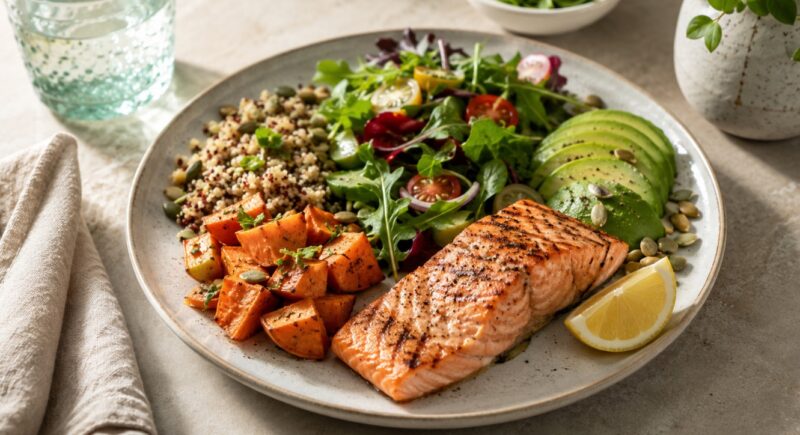
Have you ever eaten a massive, healthy-looking salad only to find yourself starving and irritable ninety minutes later? It is a common frustration.
Reclaiming our vitality does not require us to adopt a lifestyle of monastic deprivation. Instead, it requires us to design our meals with a focus on stability. If we want to maintain sharp cognitive focus and steady physical endurance throughout the day, our primary goal must be the elimination of dramatic glucose fluctuations.
This is achieved not by eliminating carbohydrates, but by buffering them. When we pair a complex carbohydrate with a high-quality protein and a healthy fat, we slow down the rate of digestion. Instead of a sharp, destabilizing spike in blood sugar, we receive a slow, metered release of energy. It is the difference between throwing dry pine needles onto a campfire—producing a sudden, blinding flash of heat followed by immediate cold—and placing a seasoned oak log on the embers.
Furthermore, we must pay closer attention to the building blocks of our physical structure. Sarcopenia—the gradual, natural loss of muscle mass—begins to accelerate after forty. Muscle is our most active metabolic tissue; it is where we burn the vast majority of our energy. To preserve this engine, we must prioritize protein density throughout the day, rather than backloading it all into a single, heavy evening meal. This means incorporating clean sources like wild salmon, pasture-raised eggs, organic chicken, lentils, and pumpkin seeds into our early meals.
The Nervous System and Digestion

There is also an emotional and neurological dimension to how we nourish ourselves. Many of us spend our working hours in a state of chronic, low-grade sympathetic activation—the classic “fight or flight” response. We eat while answering emails, scrolling through news feeds, or driving between commitments.
When we eat under stress, our digestive tract is physically compromised. Blood flow is diverted away from the gut to our limbs, stomach acid production drops, and the gut barrier becomes more permeable. We can consume the most nutrient-dense meal on the planet, but if our nervous system is in a state of alarm, our ability to absorb those nutrients is significantly impaired.
Creating a deliberate buffer between our work and our food—even just taking three deep breaths before our first bite—is not a soft lifestyle recommendation; it is a biological necessity. It transitions the body into the parasympathetic state required for optimal digestion and assimilation.
Ultimately, the shift we experience in midlife is not a decline, but an invitation. It is an opportunity to move away from the careless, reactive habits of our youth and toward a more conscious, elegant relationship with our bodies. When we treat nutrition not as a tool for weight management, but as a foundation for daily energy, we find that our best years are not behind us—they are simply operating on a more refined frequency.